Downloads

FlowSight Brochure

Amnis ImageStreamX

App Notes

Cell Cycle with FS

Immunophenotyping with FS


Company website

Amnis


You might also be interested in:

AMG

Cellomics

Essen

Amnis

Integrating flow cytometry and

microscopy to advance discovery 

The FlowSight

Flow Cytometry with Vision 

Capable: Sensitive and flexible for every need

The FlowSight offers high performance in a small package. Its innovative design increases signal and minimizes noise to provide unmatched fluorescence sensitivity. Twelve standard detection channels simultaneously produce brightfield, darkfield and up to ten channels of fluorescence imagery of every cell. With these unique capabilities, the FlowSight enables a broad range of applications.

Amnis FlowSight - 12 channel capability

Intuitive: Easy-to-use, with imagery for every cell

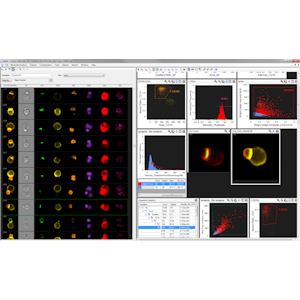
The FlowSight operates like a conventional flow cytometer but also provides imagery of every cell. Powerful and intuitive analysis software seamlessly links quantitative data to imagery:

  • Click on a dot in any plot to see the corresponding cell imagery.
  • Click on a bin in any histogram to view all the cells in that bin.
  • Draw gates on dot plots and view the resulting populations to validate results.

Amnis FlowSight - Easy to use

Affordable: Designed and priced for every lab

The FlowSight is powerful enough for the core lab but sized and priced for any lab. The system can be factory configured or field upgraded with up to four excitation lasers (405, 488, 561, 642 nm), a 96-well plate AutoSampler, and a powerful quantitative image processing option. Whether in a base configuration or fully-optioned, the FlowSight sets a new standard of value.

Amnis FlowSight - up to 4 lasers


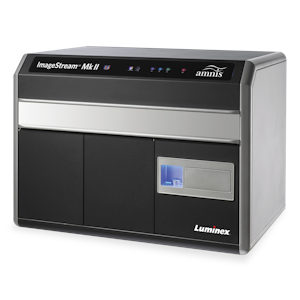
The ImageStreamX

High Resolution Microscopy in Flow 

The ImageStreamX is designed to gather more information from your cells than you ever thought possible. This breakthrough instrument is capable of imaging 1,000 cells per second with the fluorescence sensitivity of conventional flow cytometry, so you can perform image-based studies of dim markers on rare cells, even in heterogeneous samples.

The ImageStreamX can accommodate up to five excitation lasers and simultaneously acquires up to 12 images per cell, so you can combine functional studies with detailed phenotypes.

If you think all of this power comes at the expense of image quality, think again. The ImageStreamX produces imagery comparable to the best fluorescence microscopes and operates at 60X, 40X, or 20X magnification, so you can study the fine details of objects as small as bacteria and as large as epithelial cells. Only the ImageStreamX combines the speed, sensitivity, and quantitation of flow cytometry with the visual detail of microscopy in a single platform.

MODULAR OPTIONS


Five Lasers

The standard 488 nm laser may be augmented with up to four additional lasers at 405, 560, 592, and 658 nm. A high power 488 nm laser upgrade is also available for even higher sensitivity. The additional lasers greatly expand experimental flexibility by providing access to a broader palette of dyes and fluorophores.


12 Image Channels

Up to 12 channels of detection are available with the addition of an optional second camera system and associated optics. The additional channels vastly expand the scope of potential phenotypic and functional analyses.


MultiMag

The new MultiMag option provides 20×, 60× objective lenses in addition to the standard 40× lens for greater imaging flexibility and improved resolution. The 60× objective provides magnification for small objects such as yeast and bacteria as well providing greater detail with mammalian and plant cells. The 20× objective provides a wider field of view for large objects such as epithelial cells.


AutoSampler

The new AutoSampler option enhances productivity with unattended sample loading from multiwell plates. The AutoSampler allows you to easily perform dose response and time course studies.


Extended Depth of Field

EDF™ extended depth of field technology uses a combination of specialized optics and unique image processing algorithms to project all structures within the cell into one crisp plane of focus. Applications that require the enumeration of spots within the cell or nucleus, like fluorescence in situ hybridization (FISH), require an increased depth of field. EDF makes it possible to find and count spots anywhere within the cell without any sacrifice in sensitivity or speed.


Full Color Brightfield

The Full Color Brightfield option provides a full spectrum brightfield light source that allows the ImageStreamx system to replicate the RGB brightfield imagery of a microscope. This option allows brightfield to be assigned to any channel not used for flourescence, increasing experimental flexibility.


APPLICATIONS


Cell Signaling and Molecular Translocation

Measure translocation of transcription factors or membrane proteins.

Internalization

Measure the internalization of proteins or particles from the cell surface to the interior.

Morphology Analysis

Measure cellular and nuclear morphology to quantify shape change.

Co-localization

Measure molecular trafficking to organelles or the co-localization of cell surface or nuclear proteins.

Cell-Cell Interaction

Measure the accumulation of protein at the immune synapse or the inter-cellular boundary during virus-induced cell fusion.

Cell Cycle and Mitosis

Enhance cell cycle analysis with a mitotic index derived from nuclear morphology.

DNA Damage and Repair

Rapidly and objectively measure the characteristic nuclear staining of DNA repair proteins.

Cell Death and Autophagy

Quantify DNA fragmentation, the hallmark of apoptosis, and quantify LC3 clustering, the hallmark of autophagy.

Spot Counting

Quantify the number of discrete spots in images.


DISCIPLINES


The ImageStream imaging flow cytometer combines the visual power of microscopy with the speed and sensitivity of flow cytometry by digitally imaging cells directly in flow. Reveal biological phenomena using the brightness and location of fluorescence on, in, and between cells - even within rare sub-populations. Here you will find a sampling of some of the applications organized by discipline.

Biochemistry

The ImageStream provides the biochemist with the ability to measure nuclear translocation, co-localization of probes, or trafficking between organelles even in rare sub-populations.

Immunology

The ImageStream offers the immunologist the image resolution and throughput necessary to measure phagocytosis, immune synapse formation, or shape change in response to cytokines.

Oceanography

The ImageStream's tremendous speed and resolution are unmatched by any other imaging platform for oceanography.

Oncology

The ImageStream's ability to image cells directly in suspension make it a natural fit for leukemia and lymphoma research and, ultimately, clinical use. Regardless of what kind of cells you study, the ImageStream can characterize the N/C ratio, produce an accurate mitotic index, measure signal transduction, follow the uptake of drugs into cells, and measure apoptosis, all at the same time.

Hematology

The ImageStream allows the characterization of cells based both on phenotype and on nuclear and cellular morphology, texture, and other morphologic characteristics. This capability is extremely valuable for the study of hematopoiesis and leukemia/lymphoma.

Stem Cell Biology

The ImageStream has been used extensively for stem cell studies, thanks to its ability to characterize cells using both morphologic and phenotypic parameters.

Drug Discovery

With the ImageStream one can automatically sample large numbers of cells for high content analysis to screen multiple drug candidates.


About Amnis

Amnis designs, manufactures and markets leading cell imaging instrumentation for the research and clinical markets. The Company's flagship product is the ImageStream system, which combines the speed and sensitivity of flow cytometry with the power of high resolution digital microscopy. As the only technology capable of imaging cells at high speed directly in bodily fluids, ImageStream enables unique, non-invasive diagnostic applications. These applications include residual disease detection via high throughput FISH, circulating endothelial cell and tumor cell analysis, and advanced automated hematology based on multi-color phenotyping combined with histochemical staining.

Amnis was founded in 1999 and has generated ~50% annualized revenue growth since inception. The Company holds 32 issued US patents and has 55 pending patents covering applications, subsystems, and the ImageStream architecture for imaging both in flow and on substrates. Amnis is privately held and benefits from a strong investor group that includes MedVenture Associates, Crown Venture Fund, and OrbiMed Capital.

We have noticed that your browser doesn't have Javascript enabled. Our form system requires it to be enabled. Please click here for instructions on how to enable Javascript.