
Category: Customer Spotlight
Mabtech FluoroSpot in Vaccine Research | CAVA Lab


Making Every Cell Count: How the CAVA Lab Uses Mabtech FluoroSpot in Vaccine Research
Clinical trial samples are precious, particularly when researchers need to investigate multiple aspects of the immune response from a limited number of cells.
At RMIT University’s Cancer, Ageing and Vaccines Laboratory (CAVA Lab), researchers are using the Mabtech FluoroSpot FLEX: Human IFN-γ/IL-10 assay to simultaneously investigate different T cell responses following COVID-19 immunisation. By measuring two cytokines from the same sample, the team can gain more information while conserving valuable clinical trial material.
From cancer to vaccines: Meet the CAVA Lab
Led by Distinguished Professor Magdalena Plebanski, the CAVA Lab uses insights from immunology to address health needs across cancer, vaccination and healthy ageing.

The laboratory’s research spans several areas, including improving the early detection and personalised treatment of ovarian cancer, developing new immunotherapies and gold-based compounds, and investigating how ageing, gender, diet and mood influence the immune system.
Vaccination is another major area of focus. Researchers within the CAVA Lab are working to improve COVID-19 and influenza vaccines for vulnerable populations, including older adults and pregnant women. The team uses ‘omics’ approaches to profile immunity across multiple large-scale human clinical trials and is also developing synthetic nanoparticle vaccines using novel nanoparticle and adjuvant combinations.
Understanding T cell responses following COVID-19 immunisation
One area of the CAVA Lab’s research focuses on understanding T cell responses following COVID-19 immunisation.
Two cytokines of interest are IFN-γ and IL-10. The team uses IFN-γ production as an indicator of CD4 Th1 and CD8 Tc1 responses, while IL-10 indicates Tr1 activity. Measuring both therefore allows researchers to investigate different aspects of the T cell response.
The challenge is that clinical trial samples can provide a limited number of cells, making it important to maximise the information generated from every sample.
Why the CAVA Lab chose Mabtech FluoroSpot
The CAVA Lab has a long-standing connection with ELISpot, with Distinguished Professor Plebanski having been involved in pioneering the assay.
For its current research, the team selected the Mabtech FluoroSpot FLEX: Human IFN-γ/IL-10 assay because it enables both cytokines to be measured simultaneously from the same sample.
“We have a historical relationship with the ELISpot assay as our lab head was instrumental in pioneering the assay. We used this assay in particular to be able to measure both cytokines simultaneously using the same samples.”
This multiplex capability is particularly valuable when working with human clinical trial material, where every sample matters.
Making every cell count with multiplex cytokine detection
Using alternative methods, the CAVA Lab may need to measure IFN-γ and IL-10 separately. That can create a practical challenge when researchers are unable to recover enough cells from clinical samples to run multiple individual analyses.
FluoroSpot allows the team to investigate both cytokines simultaneously. As the CAVA Lab explains:
“Using other methods we would likely need to measure each analyte separately, and it can be difficult to recover enough cells from clinical samples to do this. This assay essentially halves the number of cells required.”
For the team, the ability to detect multiple cytokines simultaneously has been one of the most valuable aspects of the assay because clinical trial samples are precious and irreplaceable.
Rather than dividing a limited sample across separate cytokine measurements, multiplex FluoroSpot enables the researchers to extract more information from the cells available to them.
Supporting the PICOBOO clinical trial
The CAVA Lab is currently applying the Mabtech IFN-γ/IL-10 FluoroSpot assay as part of the PICOBOO clinical trial. The PICOBOO T cell study team is led by Dr. Kirsty Wilson, who together with Dr. Monica Prakash and Ms. Georgia Goodchild has created an optimised workflow to test T cell responses to multiple target peptide epitopes in vaccines.
Within this research, FluoroSpot provides the team with a practical way to investigate IFN-γ and IL-10 responses while conserving limited clinical samples. The ability to examine both cytokines simultaneously supports the laboratory’s broader goal of understanding immune responses following COVID-19 immunisation.
More insight from precious clinical samples
For the CAVA Lab, the value of Mabtech FluoroSpot comes down to making better use of an irreplaceable resource: clinical trial samples.
By simultaneously detecting IFN-γ and IL-10, the assay reduces the number of cells required compared with measuring each analyte separately and enables the researchers to investigate multiple aspects of T cell immunity from the same sample.
For researchers working with limited samples and looking to investigate multiple cytokines at the single-cell level, Mabtech FluoroSpot provides a multiplex approach to getting more information from every sample.
Interested in incorporating FluoroSpot into your immunology research?
Talk to the Millennium Science team about Mabtech FluoroSpot assays and how they could fit into your experimental workflow.
On this page
- Making Every Cell Count: How the CAVA Lab Uses Mabtech FluoroSpot in Vaccine Research
- From cancer to vaccines: Meet the CAVA Lab
- Understanding T cell responses following COVID-19 immunisation
- Why the CAVA Lab chose Mabtech FluoroSpot
- Making every cell count with multiplex cytokine detection
- Supporting the PICOBOO clinical trial
- More insight from precious clinical samples
- Interested in incorporating FluoroSpot into your immunology research?
Mabtech IRIS 2 in Immunology Research: Insights from Dr Liam Kealy
Introduction
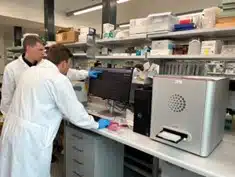
When accuracy, sensitivity, and throughput matter, immunologists are turning to advanced platforms like the Mabtech IRIS 2. Dr. Liam Kealy, Postdoctoral Researcher at Monash University, recently shared his insights into how the IRIS 2 elevated his work on plasma cells and antibody secretion and his experience working with Millennium Science. His testimonial highlights why the IRIS 2 is considered a gold standard for ELISpot, FluoroSpot, and viral focus-formation assays.

The Research Challenge: Studying Plasma Cells and Antibodies
Before adopting the Mabtech IRIS 2, Dr. Kealy and his team faced a significant challenge: the need for a multiplex approach to directly study plasma cells and the diverse antibodies they secrete. Conventional workflows lacked the flexibility and precision required for such complex immunology studies.
Gold-Standard Accuracy in Spot Detection
The Mabtech IRIS 2 solved this challenge by providing high-throughput, accurate, and user-friendly spot detection. According to Dr. Kealy:
“The IRIS 2 by Mabtech stands as the gold standard in spot detection and analysis. Equipped with advanced software, it enables high-throughput spot counting with unparalleled accuracy. Moreover, it is capable of detecting up to four colours and can provide users with additional metrics like relative spot volume.”
Applications in Immunology
This capability has opened new possibilities for his research, including ELISpots, FluoroSpots, and viral focus-formation assays. With its ability to measure multiple analytes simultaneously, the IRIS 2 enables researchers to collect richer datasets while saving time and samples.

Advanced Analysis with the Mabtech IRIS 2
The intuitive interface and advanced software tools mean researchers can move seamlessly from data acquisition to analysis. For immunologists studying antibody secretion, vaccine responses, or infectious disease mechanisms, this efficiency translates to deeper insights and faster progress.
Experience working with Millennium Science
Equally important, the collaboration with Millennium Science has played a role in supporting Dr. Kealy’s research goals. He notes:
“I always immensely enjoy chatting science with Millennium Science and working with their team to design bespoke strategies to tackle my research questions.”

Takeaway
For researchers seeking accuracy, flexibility, and high-throughput performance in multiplex immunology assays, the Mabtech IRIS 2 offers a user-friendly solution trusted by leading scientists.
Exploring the microbial landscape of No- and Low-Alcohol wines
Why watch
The fast-growing no- and low-alcohol (NOLO) category brings fresh microbiology challenges: dealcoholisation can affect microbial stability and sensory profile, and lower ethanol can increase spoilage risk. This concise session explores what’s changing in the microbial landscape – and what that means for QA.
What you’ll learn
- How dealcoholisation impacts microbial stability and the sensory profile of wines.
- An overview of >800 microorganisms isolated across process stages, and how DNA sequencing was used for identification.
- Insights from testing a subset for tolerance to ethanol and common antimicrobials.
- Practical strategies to manage spoilage and support product stability in NOLO winemaking.
Speaker
Andrea Bustos Jarufe is a Master’s candidate in Wine Microbiology at the University of Adelaide, working within the CRC-P “Advancement of Australian Lifestyle Wines”. Her research focuses on improving microbial stability and sensory quality in dealcoholised wines.
On this page
In the Lab with Dr Sabrina Sofia Burgener
Live Cell Imaging of Inflammasome Signalling
In this webinar, Dr Burgener shares how Agilent technologies, including the Cytation 5 Cell Imaging Multimode Reader, have advanced her inflammasome research by enabling high-throughput live-cell imaging over time – providing dynamic insights into inflammasome activation and signalling outputs.
What you’ll learn:
- The role of the NLRP3 inflammasome in immune defence and sterile inflammation
- Key mechanisms: CASP1 activation, cytokine release, gasdermin D cleavage, and pyroptosis
- Limitations of single-endpoint assays in inflammasome research
- How live-cell imaging enables temporal analysis of ASC speck formation, cytokine secretion, and cell death
- Newly established, standardised assays for tracking inflammasome activation in real-time
On this page
In the Lab with Dr Michael Smout
xCELLigence, Hookworms and Wound Healing with Dr Michael Smout. Webinar Recording Now Available!

Recently, Dr Michael Smout from James Cook University, provided an insightful webinar where he delved into his pioneering research on parasitic worms and their potential in advancing wound healing therapies. Central to his studies is the Agilent xCELLigence Real-Time Cell Analysis (RTCA) system, a cutting-edge technology that enables continuous, label-free monitoring of live cells.
Dr. Smout’s work focuses on the granulin protein secreted by parasitic worms, exploring its role in accelerating wound healing—a discovery that holds promise for treating chronic wounds, particularly in diabetic patients.
Webinar Highlights
- Application of xCELLigence RTCA in monitoring cellular responses to parasitic proteins.
- Insights into the therapeutic potential of parasite-derived compounds in wound healing.
- Discussion on the integration of real-time cell analysis in parasitology research.
Agilent xCELLigence RTCA System
The Agilent xCELLigence RTCA system is a state-of-the-art platform that provides real-time, label-free analysis of cellular events. By measuring electrical impedance across microelectrodes integrated into the bottom of specialised plates, the system offers dynamic monitoring of cell proliferation, morphology, and viability. Key features include:
- Continuous, non-invasive monitoring of live cells.
- High sensitivity and reproducibility in detecting cellular changes.
- Versatility across various applications, including cytotoxicity, cell adhesion, and migration assays.
This technology has been instrumental in advancing research across multiple disciplines, providing researchers with a deeper understanding of cellular behaviours in real-time.
