Planning an upcoming grant application?
The Millennium Science – 10x Genomics Grant Value Multiplier Program is designed to help Australian and and New Zealand Early and Mid Career Researchers (EMCRs) incorporate single cell and spatial biology into upcoming grant applications and get more value from their research funding.
Register your eligible grant project before submission and include 10x Genomics consumables in your proposed grant budget. If your grant is successfully awarded, you could receive an additional 50% in eligible 10x Genomics consumable value, helping you expand the scope and impact of your research.
Register your grant project using the form below:
Turn your grant funding into more research
Turn your grant funding into more research Receive an additional 50% in eligible 10x Genomics consumable value, with no maximum cap.
The Grant Value Multiplier scales with your qualifying 10x Genomics purchase. The more eligible 10x Genomics consumables included in your successful grant, the greater the additional value you can unlock.
For example only:
Planning $20,000 of eligible 10x Genomics consumables in your grant? $20,000 grant budget + $10,000 Grant Value Multiplier = $30,000 total potential 10x Genomics consumable value
That additional value could help you analyse more samples, explore more biology or extend the scope of your study, without increasing the 10x Genomics budget requested in your grant.
Who is eligible?
The program is open to Australian and New Zealand researchers and research teams preparing eligible competitive research grant applications. Early and Mid Career Researchers (EMCRs), as defined by the relevant funding scheme or institution, are particularly encouraged to apply.
You may be eligible if you:
• Are an Australian and New Zealand based researcher or research team
• Are preparing an eligible competitive research grant application
• Plan to include eligible 10x Genomics consumables in your proposed project budget
• Register your project with Millennium Science before submitting your grant application
• Proceed with the eligible 10x Genomics purchase if your grant is successfully awarded
Relevant funding opportunities may include ARC, NHMRC and MRFF schemes, as well as eligible university seed and pilot grants, philanthropic grants and disease specific research funding.
Not sure whether your grant is eligible? Register your interest and our team can help.
How it works
1. Register your grant project
Tell us about your research, funding scheme and submission deadline.
2. Plan your 10x Genomics component
Our team can help you scope the technology, experimental requirements and indicative budget.
3. Prepare your grant budget
Work with our team to determine indicative 10x Genomics requirements and obtain a quote for your grant application.
4. Include 10x Genomics in your grant application
Submit your application with eligible 10x Genomics consumables included in your proposed project budget.
5. Let us know when your grant is awarded
Once your successful grant and eligible purchase are confirmed, your project can proceed through the Grant Value Multiplier process.
6. Unlock additional research value
Receive additional eligible 10x Genomics consumables equivalent to 50% of the qualifying purchase value, subject to program terms and conditions.
More than a funding multiplier
You don’t need to have every detail of your experiment worked out before you register.
Before submission, Millennium Science and 10x Genomics can connect you with support to help plan the 10x Genomics component of your grant, including:
• Experimental scoping based on your research question
• Single cell and spatial technology selection
• Study design and sample planning
• Indicative consumable requirements and quotation support
• Technical resources and relevant publications
• Access to local service providers and core facilities where required
• 1:1 Grant Planning Sessions with our sales and technical teams
Our goal is to help you build a scientifically appropriate and realistically budgeted 10x Genomics component into your proposal.
Planning an upcoming grant?
Whether you’re planning your first single cell experiment, adding spatial biology to an established research program, or looking to increase the scale of your next study, start the conversation before you submit your application.
Register your grant project using the form below:
Have a project in mind but aren’t sure what to include in your grant? Request a 1:1 Grant Planning Session to discuss your project with the Millennium Science and 10x Genomics team.
Eligibility criteria, eligible products, qualifying grant schemes, purchase requirements and redemption periods apply. Participation and multiplier value are subject to approval under the final program terms and conditions. Atera reagents are excluded from the Grant Value Multiplier Program.
Discover how single cell spatial biology is transforming our understanding of colorectal cancer.
The Xenium platform enables researchers to profile gene expression directly within intact tissue, preserving the spatial relationships between tumour, immune and stromal cells that drive disease progression.
Why study colorectal cancer with Xenium?
Bulk sequencing averages signals across thousands of cells.
Xenium reveals individual cells within their native tissue architecture, allowing researchers to investigate:
• Tumour heterogeneity
• Immune excluded regions
• The invasive tumour front
• Cell neighbourhoods
• Spatial biomarker expression
• Tumour immune interactions
Why Xenium?
✓ Single cell, subcellular resolution• Tumour heterogeneity
✓ Spatial context preserved
✓ FFPE compatible
✓ Human Colon Gene Expression Panel
✓ Custom add-on panels
✓ RNA and protein profiling on the same tissue section
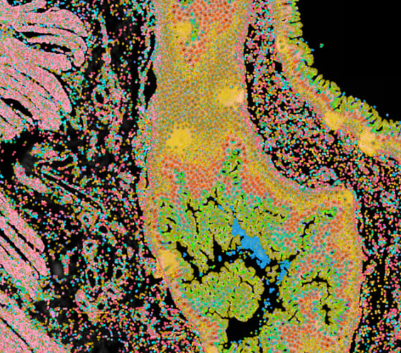
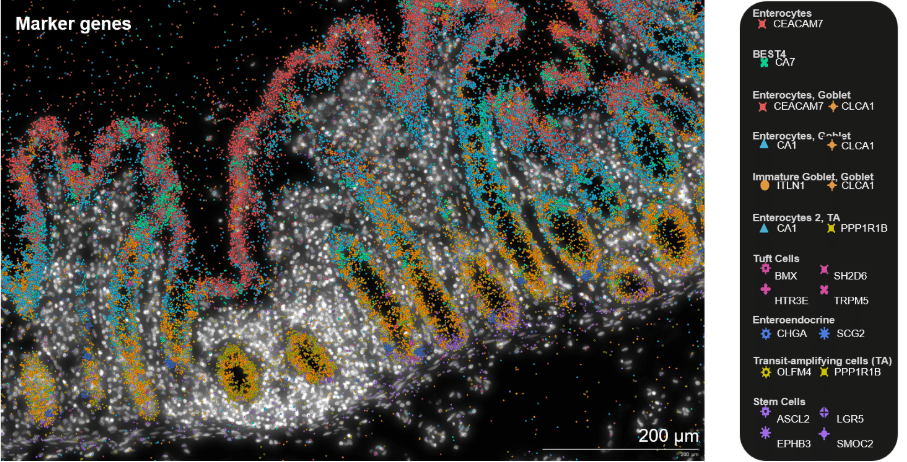
Xenium spatial transcriptomic analysis of CRC FFPE tissue. (A) RNA transcript density. (B) Multiplexed protein detection via immunofluorescence. (C) RNA clustering. (D) Post-Xenium H&E.

Formalin-fixed, paraffin-embedded (FFPE) human colorectal cancer (CRC) samples were analyzed using the Xenium Human Colon Gene Expression Panel, supplemented with 53 Immuno-Oncology–specific genes, and stained with all Xenium Protein subpanels. Over 1.7 million cells were profiled for both RNA and protein expression.
10x Genomics Clinician Researcher Accelerator Program
Clinical research is increasingly driven by the need to understand biological heterogeneity, identify actionable biomarkers, and link molecular mechanisms to patient outcomes. Traditional bulk and low-resolution approaches often mask clinically relevant signals, slowing discovery and translation. 10x Genomics technologies accelerate clinical research by enabling cell-resolved and spatially resolved insights at scale at earlier in the research pipeline.
A targeted Clinician Researcher Accelerator Program designed to support medically qualified clinician researchers in generating high-impact spatial and single-cell data, with dedicated support and preferential pricing to fast-track translational research.
The Clinician Researcher Accelerator Program is a limited-time initiative supporting medically qualified clinician researchers who are looking to integrate spatial transcriptomics and single-cell profiling into their research. Successful applicants will receive access to dedicated technical guidance, and preferential pricing to help generate robust pilot data for translational and clinically focused studies.
1. Resolving clinical heterogeneity at single-cell resolution
Many clinical samples including tumours, immune tissues, and biopsies, are highly heterogeneous. Bulk profiling averages signals across cell populations, obscuring rare or disease-driving cell states.
Chromium Single Cell technologies enable researchers to:
Identify rare or pathogenic cell populations
Characterise immune cell diversity and activation states
Study patient-to-patient variability at cellular resolution
Clinical impact:
Earlier identification of clinically relevant subpopulations improves hypothesis generation, patient stratification strategies, and biomarker discovery.
2. Linking molecular signals to tissue context
Understanding where cells are located within tissue is critical for clinical interpretation, particularly in oncology, immunology, and pathology-driven research.
Visium Spatial Gene Expression allows researchers to:
Map gene expression within intact tissue sections
Correlate molecular patterns with histology
Identify spatially distinct disease niches
Clinical impact:
Spatial context strengthens biological interpretation, supports translational relevance, and enables more compelling mechanistic narratives for grants and publications.
3. Translating discovery into spatial validation
Discovery technologies are most powerful when paired with targeted validation in clinically relevant samples.
Direct visualisation of clinically relevant gene signatures
Confirmation of biomarkers within preserved tissue architecture
Clinical impact:
Xenium supports the transition from discovery to validation which is a critical step for translational studies, diagnostic development, and clinical adoption.
4. Accelerating the path from pilot data to funding
Clinical research is often constrained by:
Limited sample availability
Ethical and governance considerations
The need to justify scale and cost upfront
10x Genomics platforms are well suited to small, high-information pilot studies, allowing researchers to:
De-risk experimental design
Generate convincing preliminary data
Strengthen ARC, NHMRC, and translational grant applications
Clinical impact:
High-quality pilot data reduces uncertainty and accelerates progression to larger, funded studies.
5. Enabling multi-modal clinical insights
Complex clinical questions rarely have single-dimensional answers.
10x Genomics workflows support:
Integration of transcriptomics, immune profiling, and spatial biology
Cross-platform studies linking cell state, location, and function
More comprehensive biological models of disease
Clinical impact:
Multi-modal data improves robustness, reproducibility, and translational relevance which is increasingly expected by reviewers and collaborators.
6. Supporting reproducibility and scalability in clinical settings
Clinical research demands consistency, robustness, and scalability.
10x Genomics technologies are:
Highly standardised and widely adopted
Supported by validated workflows and protocols
Designed for reproducible data generation across sites
Clinical impact:
Standardisation supports multi-centre studies and facilitates collaboration between hospitals, academia, and industry.
Apply for the Clinician Researcher Accelerator Program now!
One winner will be awarded 50% discount across Xenium v1 or 5k Prime panel*(2 slides) and Xenium running consumables Or One Flex kit (16-sample configuration)
All approved applicants will receive a 25% discount
Orders must be placed by 19 June 2026
*Custom panels excluded.
Application timeline
• Applications close: 27 May 2026
• Outcome notification: 1 June 2026
Fill in the form below to submit your application now!
Graduate students and early to mid-career researchers with no prior hands-on experience using 10x Genomics technologies are invited to apply for the prestigious 2026 Millennium Science – 10x Genomics Fellowship Program.
This Fellowship is designed to support researchers who are keen to adopt cutting-edge single-cell and spatial technologies in their work.
Important Dates
Applications close: 16 March 2026
Outcomes announced: 30 March 2026
Fellowship Focus: FFPE Samples
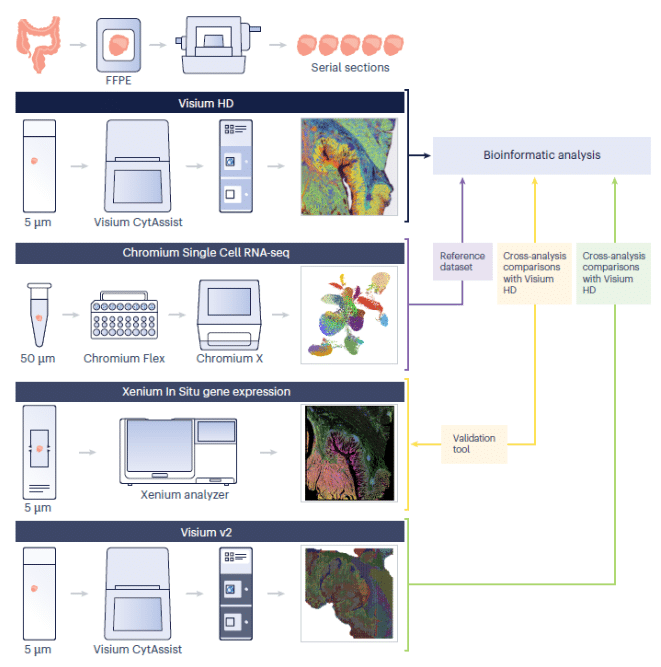
The 2026 Fellowship Program focuses on the application of 10x Genomics technologies to FFPE samples, using one or more of the following platforms: Chromium Single Cell Visium Spatial Xenium In Situ (NEW within the Fellowship Program!)
Fellowship Benefits
Successful applicants will receive:
A personalised mentoring session on experimental design with a 10x Genomics specialist
Dedicated support from the Fellowship Program Coordinator
10x Chromium or Visium CytAssist demo instrument placement (if required and subject to availability)
Support with project onboarding through a core facility running 10x Genomics platforms (Chromium, Visium or Xenium)
Discounted 10x Genomics consumables*
Invitation to present at Millennium Science–10x Genomics events
Membership in the Millennium Science–10x Genomics Fellows Network
Fellowship-exclusive merchandise
A certificate confirming completion of the Fellowship Program
Applications will be assessed by a panel of scientific experts from Millennium Science and 10x Genomics, based on project innovation, feasibility, and potential to inspire future research.
Through this program, Millennium Science and 10x Genomics aim to empower early and mid-career researchers to generate high-quality pilot data using advanced multi-omics technologies, supporting future experimental design and funding applications. *Please note, the Fellowship is not associated with provision of free reagents. Discounts cannot be combined with other promotions.
Application Details
To apply, please submit:
Project title: 20 words maximum
Abstract: 250 words maximum
CV: Attach 1-page CV
Letter of Support: Please provide a letter of support from the principal investigator of the laboratory. Additional institutional or departmental letters of reference may be submitted to support the application.
Completion of the online application survey below is required to submit your application.
Applications will be reviewed by Millennium Science as they are being received. Successful applicants will be notified via email.
Conditions of Eligibility
No previous personal experience using 10x Genomics technologies
Open to graduate students and early to mid-career researchers (up to 15 years post-PhD; special circumstances may be considered with supporting documentation)
Selected candidates must complete the specified individualised training program prior to reagent delivery or instrument placement
Applicants must be based in Australia or New Zealand
Hear from Our 10x Genomics Fellowship Alumni
“I was fortunate to receive the Millennium Science-10x Genomics Fellowship in 2021 during my first postdoctoral appointment in Associate Professor Megan Wilson’s lab at the Department of Anatomy, University of Otago, where her lab studies whole-body regeneration in the marine tunicate Botrylloides diegensis. At a time when single-cell technologies were still emerging, the Fellowship enabled us to rapidly adopt 10x Genomic technology and interrogate this process at unprecedented resolution. After some optimisation, our first 10x run produced a high-quality dataset that underpinned a recent publication in Development. Importantly, the Fellowship established long-term single-cell capability in the lab, directly benefiting lab member Berivan Temiz, who applied this method extensively during her PhD. I continue to find 10x Genomics the most user-friendly and straightforward to implement.” Michael Meier
“I moved to Melbourne in 2015 from Phuket, Thailand to pursue my passion for biomedical science. I completed my PhD at Monash University in 2023,investigating how epigenetic mechanisms shape B-cell biology, particularly the role of the histone methyltransferase DOT1L in regulating immune cell identity and function. My research is driven by a desire to understand how immune cells adapt in different disease contexts and how gene regulation disruptions contribute to chronic inflammatory conditions. In early 2023, I was honoured to receive the Millennium Science-10x Genomics Fellowship, which has been pivotal in advancing this work. With their support, I implemented single-cell multiome sequencing to profile circulating B cells from individuals with chronic disease, including Long COVID-a debilitating, multi-system syndrome that remains poorly understood. By measuring gene expression and chromatin accessibility in the same cell, this approach reveals subtle immune signatures and hidden cellular states, opening new avenues for diagnosis and treatment. The Fellowship provided not only advanced technology, but also personalised mentorship, technical guidance, and connection to a collaborative network of fellows across Australia and New Zealand. This support has accelerated my research and positioned me to tackle ambitious questions about immune dysfunction in complex diseases like Long COVID.” Liam Kealy