Advance Colorectal Cancer Research with Xenium X-Frontier Program

Advance Colorectal Cancer Research with Xenium

Discover how single cell spatial biology is transforming our understanding of colorectal cancer.

The Xenium platform enables researchers to profile gene expression directly within intact tissue, preserving the spatial relationships between tumour, immune and stromal cells that drive disease progression.

Why study colorectal cancer with Xenium?

Bulk sequencing averages signals across thousands of cells.

Xenium reveals individual cells within their native tissue architecture, allowing researchers to investigate:

• Tumour heterogeneity

• Immune excluded regions

• The invasive tumour front

• Cell neighbourhoods

• Spatial biomarker expression

• Tumour immune interactions

Why Xenium?

✓ Single cell, subcellular resolution• Tumour heterogeneity

✓ Spatial context preserved

✓ FFPE compatible

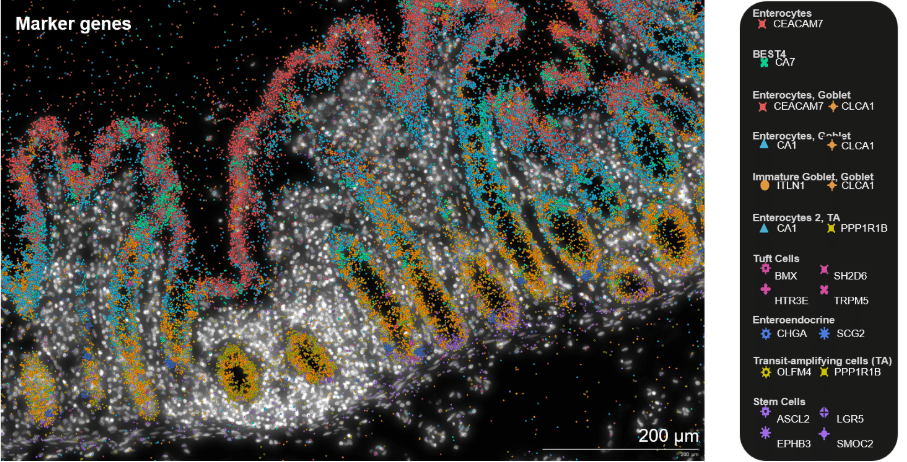
✓ Human Colon Gene Expression Panel

✓ Custom add-on panels

✓ RNA and protein profiling on the same tissue section

Featured Resources

Human Colon Gene Expression Panel (322 genes + add-on up to 100 genes)


Targeted cell types: absorptive enterocytes, enteroendocrine cells, goblet cells, paneth cells, fibroblasts, vascular endothelium, immune cells

Multiomic RNA and Protein workflow


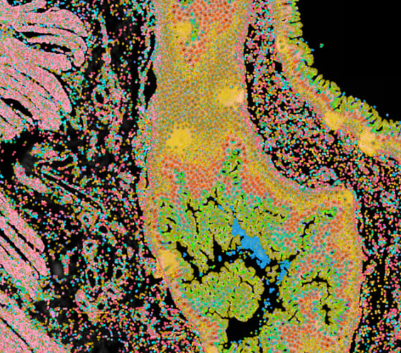
Xenium spatial transcriptomic analysis of CRC FFPE tissue. (A) RNA transcript density. (B) Multiplexed protein detection via immunofluorescence. (C) RNA clustering. (D) Post-Xenium H&E.

Formalin-fixed, paraffin-embedded (FFPE) human colorectal cancer (CRC) samples were analyzed using the Xenium Human Colon Gene Expression Panel, supplemented with 53 Immuno-Oncology–specific genes, and stained with all Xenium Protein subpanels. Over 1.7 million cells were profiled for both RNA and protein expression.

10x Genomics public datasets

Featured publications

  1. High-definition spatial transcriptomic profiling of immune cell populations in colorectal cancer – Oliveira, Michelli Faria de, et al. Nature Genetics 57 (2025): 1512-1523.

Mapping the colorectal tumour microenvironment at single cell resolution

  • Identified distinct macrophage populations in different tumour niches
  • Revealed spatial interactions between tumour and immune cells
  • Uncovered potential biomarkers for immunotherapy and patient stratification

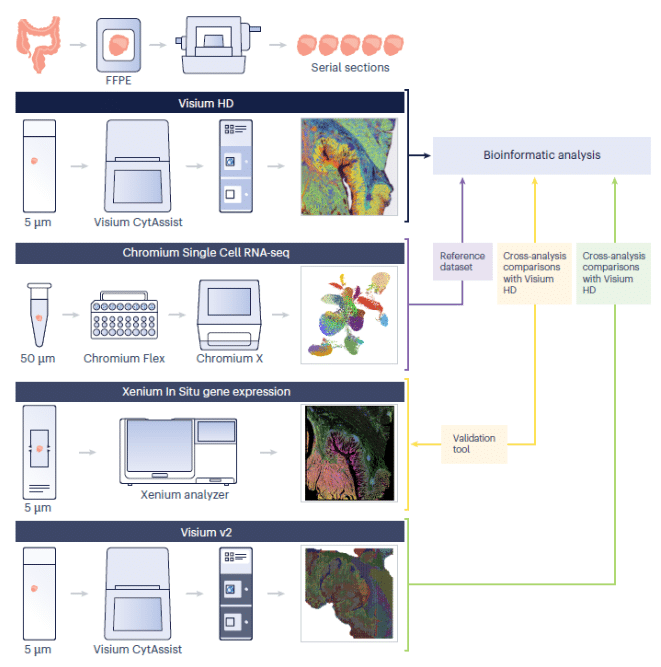
Powered by Visium HD discovery and Xenium single cell validation.


Integrated workflow combining whole transcriptome discovery, single cell profiling, and Xenium spatial validation. Adapted from Oliveira, Michelli Faria de, et al. Nature Genetics 57 (2025): 1512-1523.

Exclusive Campaign Offer

New to Xenium? 30% OFF your first Xenium kit*

Existing Xenium users? 15% OFF your next Xenium kit*

Orders must be placed by 30 September.

*Excludes Xenium Prime 1k and 2k custom panels. First kit only.

✉ 10xgenomics@mscience.com.au