
MycoStrip® 2.0 Mycoplasma Detection Kit: Rapid Mycoplasma Testing for Cell Culture


Sensitive, simple mycoplasma detection in under an hour. No special equipment needed.
Mycoplasma contamination is one of the most common and least visible threats to cell culture. It can’t be seen under a microscope, slips through standard 0.2 µm filters and quietly skews your results. MycoStrip® 2.0 from InvivoGen is a rapid mycoplasma detection kit that uses isothermal PCR and a simple lateral flow strip to give you a clear answer in about 45 minutes. Millennium Science supplies MycoStrip® 2.0 to researchers across Australia and New Zealand, with local support from our team.
Key benefits of MycoStrip 2.0:
- Sensitive: detects as little as 1 genome copy (GC)/µl (~1 CFU/ml)
- Fast: results in 30 minutes of incubation, about 45 minutes in total
- Simple: only a heating device needed, such as a thermocycler, heat block or water bath
- Clear: read 1 or 2 bands on the strip within 2 to 5 minutes
- Specific: no cross-reactivity with other bacterial, fungal or mammalian DNA
- Sustainable: cassette-free format available to cut plastic waste
Why mycoplasma testing in cell culture matters
Mycoplasma are the smallest self-replicating organisms, at around 100 nm. They have no cell wall, so common antibiotics such as penicillin and streptomycin don’t touch them. They pass straight through standard 0.2 µm filtration and can’t be seen by eye or under a light microscope. That means a culture can look perfectly healthy while its biology is being rewritten.
Once established, mycoplasma compete with your cells for nutrients, alter metabolism and growth, change the expression of hundreds of genes and interfere with signalling and cytokine production. Their lipoproteins activate TLR2, which makes contamination especially damaging in immunology work with macrophages and other immune cells.
Mycoplasma by the numbers:
- Up to 35% of cell cultures are contaminated worldwide, including cell bank stocks
- 95% of contamination comes from just six species: M. orale, M. hyorhinis, M. arginini, M. fermentans, M. hominis and A. laidlawii
- 80% of lab operators carry mycoplasma, and talking or sneezing near cultures can spread it
- 50% of US labs don’t routinely test their cultures
Top reasons to test routinely:
- Protect precious cell lines, primary cells and clones
- Safeguard data reliability and reproducibility
- Meet journal requirements: most journals now ask for proof of mycoplasma-free cultures
- Avoid lost time, reagents and funding
MycoStrip® 2.0 detects contamination at around 1 CFU/ml, long before it reaches the levels where results are typically affected (approximately 10⁷ CFU/ml). InvivoGen recommends testing cultures every 2 to 3 weeks and quarantining all new cell lines until they test negative.
How MycoStrip® 2.0 rapid mycoplasma testing works
MycoStrip® 2.0 uses loop-mediated isothermal amplification (LAMP), a form of isothermal PCR run at a constant 65°C. A proprietary Reaction Mix, featuring a next-generation enzyme, amplifies a conserved region of the 16S rRNA gene found across Mollicutes, the class that includes Mycoplasma, Acholeplasma, Ureaplasma and Spiroplasma. The amplified DNA is then read on an immunochromatographic (lateral flow) strip. No DNA extraction, gel electrophoresis or thermal cycling program is required.
4 easy steps to detect mycoplasma in your cell cultures
- Prepare your sample (~5 min): collect 1 ml of cell culture supernatant or FBS. Heating at 95°C for 5 minutes is optional but recommended to inactivate mycoplasma.
- Incubate at 65°C for 30 minutes: combine the Reaction Mix, Reaction Buffer and sample. Extend to 50 minutes for maximum sensitivity (do not exceed 60 minutes).
- Stop the reaction and load the cassette: add Migration Buffer and transfer the sample to the strip.
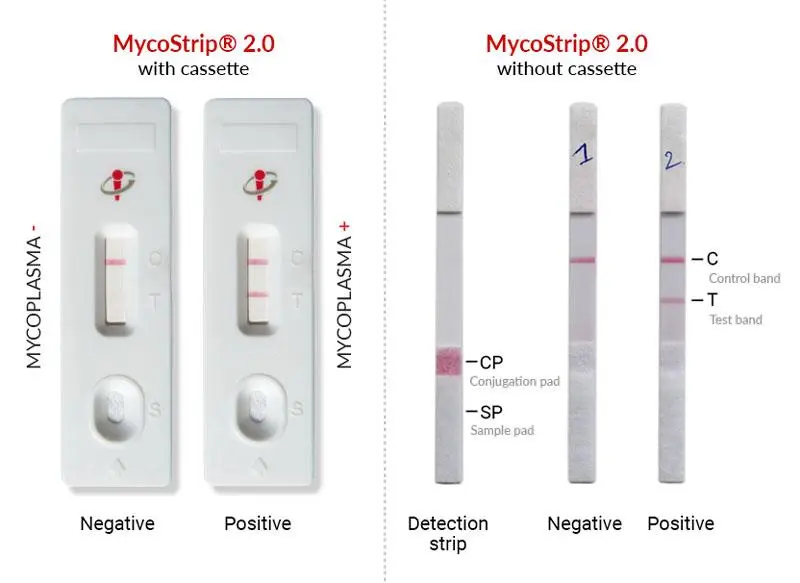
- Read your results within 2 to 5 minutes: one band (control) means negative, two bands mean positive.
What equipment do I need?
Just a heating device that holds 65°C (±5°C): a thermocycler, heat block, dry bath or water bath. MycoStrip® 2.0 has improved tolerance to temperature variation, so it performs reliably across standard lab equipment. Note that water baths can increase contamination risk.
Who is it for?
- Cell culture labs running routine contamination checks
- Core facilities and cell banks managing many lines
- Researchers preparing data for publication
- QC and quality assurance workflows in biotech and pharma research
What's new in MycoStrip® 2.0
MycoStrip® 2.0 is faster, more sensitive and more robust than the original MycoStrip®, thanks to an optimised high-performance enzyme.
| Feature | MycoStrip® (original) | MycoStrip® 2.0 |
|---|---|---|
| Incubation at 65°C | 40 min | 30 min |
| Sensitivity | 10 to 100 CFU/ml | 10 to 100 GC/µl in 30 min; down to 1 GC/µl in 50 min |
| Genera detected | Mycoplasma, Acholeplasma | Adds Ureaplasma and Spiroplasma |
| Temperature tolerance | Standard | Improved tolerance to temperature variation |
Why GC/µl? Sensitivity is now reported in genome copies per µl, in line with European Pharmacopoeia edition 12.2, which favours molecular quantification. Based on in-house digital PCR studies, InvivoGen considers 1 GC/µl roughly equivalent to 1 CFU/ml for the most common contaminants.
MycoStrip® 2.0 specifications
| Specification | Detail |
|---|---|
| Application | Detection of mycoplasma contamination in cell cultures |
| Method | LAMP (isothermal PCR) with colorimetric lateral flow strip |
| Target | Conserved region of the 16S rRNA gene of Mollicutes |
| Sample types | Cell culture supernatant (adherent or suspension cultures), FBS |
| Sample volume | 1 ml |
| Limit of detection | 1 GC/µl (~1 CFU/ml) with 50 min incubation |
| Assay time | ~45 min total (15 min hands-on) |
| Readout | 1 band negative, 2 bands positive, within 2 to 5 min |
| Specificity | No cross-reactivity with other bacteria, fungi or eukaryotic DNA |
| Species validated | 56 Mollicute species, including the 6 species behind 95% of contamination |
| Live and dead mycoplasma | Detects both |
| Positive control | Included |
| Equipment | Heating device at 65°C (±5°C) |
| Shipping and storage | Shipped at room temperature; store all components at -20°C |
| Stability | 18 months at -20°C; avoid repeated freeze-thaw |
| Quality control | Each lot functionally tested and validated |
| Use | For research use only. Not for human or veterinary use |
See the full list of 56 Mollicute species tested on the InvivoGen product page.
Available Kit Formats
MycoStrip® 2.0 comes with or without cassettes. The cassette-free format is more economical and reduces plastic waste.
| Product | Format | Pack size | Cat. code |
|---|---|---|---|
| MycoStrip® 2.0 | With cassette | 10 tests | rep-mysv2-10 |
| MycoStrip® 2.0 | With cassette | 20 tests | rep-mysv2-20 |
| MycoStrip® 2.0 | With cassette | 50 tests | rep-mysv2-50 |
| MycoStrip® 2.0 | Without cassette | 50 tests | rep-mysncv2-50 |
| MycoStrip® 2.0 | Without cassette | 100 tests | rep-mysncv2-100 |
What if my test is positive?
Don’t stress. Precious cultures can usually be rescued with InvivoGen’s anti-mycoplasma reagents, also available from Millennium Science.
- Plasmocin® treatment: first-line elimination reagent that clears mycoplasma in about 2 weeks, with little to no toxicity to mammalian cells
- Plasmocure™: second-line option for Plasmocin®-resistant strains, using antibiotics with different mechanisms of action
After treatment (~2 weeks), re-test with MycoStrip® 2.0 and compare against your original sample. Keep an untreated backup vial so you can confirm the result or start again if needed. To prevent future contamination, consider adding Normocin™ or Plasmocin® prophylactic to routine culture media.
MycoStrip® 2.0 Frequently Asked Questions
What is the principle of the MycoStrip® 2.0 mycoplasma test? It uses LAMP isothermal PCR at a constant 65°C to amplify a conserved region of the Mollicute 16S rRNA gene. The amplified DNA is shown as a band on a lateral flow strip.
How sensitive is MycoStrip® 2.0? It detects 10 to 100 GC/µl with a 30-minute incubation, and as little as 1 GC/µl (~1 CFU/ml) when incubated for 50 minutes. Incubating longer than this won’t improve detection.
How long does the test take? About 45 minutes in total, with 15 minutes of hands-on time.
What equipment do I need? Only a heating device set to 65°C, such as a thermocycler, heat block, dry bath or water bath.
What samples can I test? 1 ml of cell culture supernatant from adherent or suspension cultures, or media components such as FBS. Mammalian cells in the sample do not interfere.
Does it detect bacteria other than mycoplasma? No. It is specific to Mollicutes and does not detect related bacteria such as Clostridium, Salmonella, Streptococcus or Achromobacter.
Does MycoStrip® 2.0 detect live and dead mycoplasma? Yes. Detecting both gives a fuller picture of contamination, including recent events and residual DNA.
Will antibiotics in my culture medium affect the result? No. You can test cells grown with antibiotics.
Is the positive control a contamination risk? No. It contains only a DNA fragment, not live mycoplasma.
What should I do if I see a faint band? Extend the 65°C incubation to 50 minutes. If the band is still faint, treat the result as negative. You can also grow cells to full confluency for 48 hours and re-test.
How should I store the kit? It ships at room temperature. Store all components, including strips, at -20°C, where they are stable for 18 months. Aliquot the Reaction Mix and Positive Control to avoid repeated freeze-thaw.
Can I use reagents from the original MycoStrip® with MycoStrip® 2.0? No. The reagents are not interchangeable.
Can I buy MycoStrip® 2.0 in Australia and New Zealand? Yes. Millennium Science is InvivoGen’s distributor in Australia and New Zealand. Request a quote and our team will get back to you.
Documents and Resources
Ready to put mycoplasma on notice?
Get fast, clear mycoplasma testing for your cell cultures with MycoStrip® 2.0. Our team can help with pricing, pack sizes and the right workflow for your lab.
For research use only. Not for human or veterinary use. MycoStrip® is a trademark of InvivoGen.
On this page
- Sensitive, simple mycoplasma detection in under an hour. No special equipment needed.
- Why mycoplasma testing in cell culture matters
- How MycoStrip® 2.0 rapid mycoplasma testing works
- What equipment do I need?
- What's new in MycoStrip® 2.0
- MycoStrip® 2.0 specifications
- Available Kit Formats
- What if my test is positive?
- MycoStrip® 2.0 Frequently Asked Questions
- Documents and Resources
- Ready to put mycoplasma on notice?